Our Publications
EurEau position on the draft Regulation establishing a framework of measures for strengthening Europe’s cloud and AI ecosystem
Enhancing our cloud and AI capacity must not go to the detriment of local water resilience
EurEau Position on wastewater sector; utilities procurement regime
The EU’s proposed procurement framework treats drinking water and wastewater differently, despite their similar operational characteristics.
EurEau calls for wastewater treatment to be recognised as an autonomous utility activity, bringing the whole water sector under a unified procurement regime.
EurEau input to draft guidance on ‘do no significant harm’ (MFF)
Targeted public consultation – draft guidance on the application of the ‘do no significant harm’ principle under the 2028-2034 Multiannual Financial Framework (MFF)
Regulating Water Reuse: A water services sector contribution to discussions on future reuse policy
EurEau calls for a voluntary, locally driven approach to water reuse, recognising wastewater operators as strategic partners in promoting water reuse in line with the EU Water Resilience Strategy while protecting drinking water resources. It also calls for full cost recovery for water reuse, and sees no need to extend the current Water Reuse Regulation to additional uses, including industrial reuse.
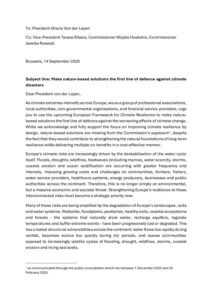
letter: Make nature-based solutions the first line of defence against climate disasters
As climate extremes intensify across Europe, we as a group of professional associations, local authorities, non-governmental organisations, and financial service providers, urge you to use the upcoming European Framework for Climate Resilience to make nature-based solutions the first line of defence against the worsening effects of climate change.
EurEau Recommendations on the Digital Transition of the Water Services Sector
These recommendations call for an enabling, risk-aware approach to digitalisation, focused on reliability, security and continuity of essential water services. They emphasise readiness, good governance, data quality and proportionate implementation, while recognising both the opportunities and risks for water utilities.
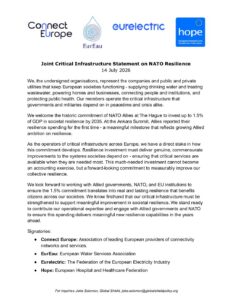
Joint Critical Infrastructure Statement on NATO Resilience
Associations representing critical infrastructure statement to NATO, call for investment to improve resilience
Annual Report 2025
From helping shape the EU Water Resilience Strategy to defending the Polluter Pays Principle, advocating for stronger protection against PFAS, and celebrating 50 years of bringing Europe’s water professionals together, 2025 showed why water must remain at the heart of Europe’s future.
Inside the report you’ll find:
💧 Our policy achievements
💧 Key advocacy milestones
💧 New publications and technical work
💧 The people and partnerships behind our work
💧 What comes next for Europe’s water sector
Thank you to all our members, experts and partners who contributed throughout the year.
Europe’s Water in Figures
Europe’s water services providers continue to deliver safe drinking water and wastewater services to most people across the continent. But behind this strong performance, ageing infrastructure, rising costs and new environmental challenges are putting future resilience at risk.
Europe’s Water in Figures – 2025 snapshot
An overview of Europe’s water stats in 2025